
Deciding Between Emergency Dispatch and Next-Day Service for Industrial Refrigeration Faults
A late-night control panel alert forces a stressful choice between risking inventory and paying after-hours fees. We share our triage framework to help you make the right call.

Evaluating Panel Alerts: Do You Need 24/7 Industrial Refrigeration Service Utah?
When a late-night control panel alert suddenly blares, Deciding Between Emergency Dispatch and Next-Day Service for Industrial Refrigeration Faults is a high-stakes call for any facility manager. You are immediately faced with the stressful reality of potential inventory loss, weighed against the urgency of an after-hours response. Is that alert signaling a catastrophic failure, or is it just a temporary sensor glitch? The right decision protects your product; the wrong one either risks your assets or incurs unnecessary operational costs, which is why knowing exactly when to call for 24/7 emergency service is crucial.
Here at Reinhardt Refrigeration Heating & Cooling, our team has spent years responding to after-hours calls across Duchesne, UT, and the greater Uintah Basin. In our experience, many midnight panics can actually wait for standard operating hours. We frequently see alerts triggered by September early fall ambient temperature transitions, where sudden weather shifts temporarily confuse system sensors rather than indicating true mechanical failures. As an honest partner in your facility's operation, our goal is to help you accurately diagnose the situation at the panel so you can avoid unnecessary emergency dispatch fees whenever it is safe to do so.
Before you request comprehensive commercial refrigeration services in the middle of the night, it is critical to evaluate the specific symptoms your system is displaying. Understanding the difference between a critical fault and a non-critical alert requires a calm, methodical approach to triage. By evaluating the immediate data provided by your control panel and understanding your system's thermal retention capabilities, you can make an informed, confident decision about whether to dispatch a technician immediately or schedule next-day diagnostics.
The Initial Assessment: How Long Can Your System Safely Hold Temperature?
When an alert triggers, the first step is to establish a baseline understanding of your system's current temperature retention. Panic often sets in immediately, but well-insulated commercial walk-ins and industrial freezers possess significant thermal mass. This means that even during a minor fault, a fully stocked, tightly sealed unit can often maintain safe internal temperatures for several hours. Understanding this buffer zone is essential for reducing immediate stress and allowing for a proper triage process.
The FDA Food Code provides strict guidelines for perishable inventory, requiring foods to remain at 41 degrees Fahrenheit or below to prevent bacterial growth and ensure safety. However, the air temperature inside the box fluctuates much faster than the actual core temperature of your stored product. If a fault occurs, the immediate priority is protecting that core product temperature.
To accurately assess how long your system can safely hold temperature, follow these precise monitoring steps before making a dispatch decision:
1. Lock down the environment: The absolute most critical step is keeping all doors completely sealed. Every time a walk-in door is opened to "check on things," heavy thermal loss occurs. Restrict all personnel access immediately.
2. Identify the fault code: Check the control panel to see if you are looking at compressor lockout faults vs. minor temperature drifts. A lockout means cooling has stopped entirely, while a minor drift might just mean the system is struggling or entering a defrost cycle.
3. Record the initial temperature: Note the exact ambient air temperature reading on the digital display the moment the alarm sounds.
4. Monitor the 30-to-60-minute trend: Wait half an hour without opening the doors. If the temperature rises rapidly (e.g., several degrees in 30 minutes), you are losing thermal control. If it rises by only a fraction of a degree or stabilizes, your insulation and thermal mass are successfully holding the environment.
If your 60-minute assessment reveals a stable environment well below the FDA 41-degree threshold, you likely have the operational runway to wait for standard next-day service. If the temperature is climbing steadily toward the danger zone, immediate intervention is required.
Critical Failures: When Immediate Dispatch is Non-Negotiable
While many alerts are benign, certain symptoms definitively indicate a catastrophic failure. When these specific issues arise, the risk of rapid inventory loss and severe equipment damage makes an after-hours emergency response strictly non-negotiable. Knowing how to identify these severe symptoms ensures you don't hesitate when your facility's assets are genuinely on the line.
The Problem: Active Refrigerant Leaks
If you hear a distinct hissing sound near the condenser or evaporator coils, or if you spot visible oil pooling beneath the refrigeration lines, you are dealing with an active refrigerant leak.
The Cause: High-pressure lines can develop micro-fractures from vibration, corrosion, or sudden pressure spikes. When refrigerant escapes, the system rapidly loses its ability to transfer heat.
The Solution: This requires immediate dispatch. The system must be shut down, the leak brazed and sealed, and the exact volume of refrigerant recharged to prevent the compressor from pulling a vacuum and destroying itself.
The Problem: Complete Power Loss to the Condenser
If the indoor control panel is functional but the outdoor condenser unit is completely dead, and resetting the dedicated breaker results in an immediate, repeated trip.
The Cause: A repeatedly tripping breaker indicates a dead short in the electrical system, a grounded compressor winding, or a catastrophic electrical failure.
The Solution: Never force a breaker to stay on. Leave the power off and request emergency service to trace the electrical fault before it causes a fire hazard or ruins the remaining electrical components.
The Problem: Mechanical Grinding Noises
Loud, metal-on-metal screeching or heavy grinding sounds emanating from the compressor shell are severe warning signs.
The Cause: This typically points to internal mechanical failure, often due to oil starvation or liquid slugging (where liquid refrigerant enters the compressor cylinder).
The Solution: Shut the system down immediately to focus on preventing compressor burnout. An emergency technician must assess the internal damage and correct the oil or refrigerant flow before the compressor seizes entirely.
Identifying a Hard Compressor Lockout
A hard lockout is one of the most common critical emergencies our team diagnoses on industrial control panels. When comparing compressor lockout faults vs. minor temperature drifts, a hard lockout means the system's internal safety switches have completely severed power to the compressor to prevent it from destroying itself. This is often triggered by extreme high head pressure or dangerously low suction pressure.
When a hard lockout occurs, a specific red fault light or digital error code will display on the panel. The most important rule for facility managers is to never repeatedly attempt to bypass or reset a hard lockout without professional diagnostics. Forcing the system to restart bypasses the very safety mechanisms designed to protect your most expensive component. With our specialized expertise in Uintah Basin industrial refrigeration systems, we strongly advise treating a hard lockout as an immediate emergency dispatch to protect both your inventory and your infrastructure.
Safe for Standard Hours: Recognizing Non-Critical Faults and False Alarms
Not every flashing light on a refrigeration panel spells disaster. In fact, many alerts are built-in warnings designed to notify you of minor operational deviations long before they threaten product safety. Recognizing these non-critical faults saves your facility unnecessary emergency fees and allows you to address the issue during standard operating hours.
Minor Ambient Temperature Sensor Drifts: Industrial sensors are highly sensitive. We frequently see alerts triggered by September early fall ambient temperature transitions, where the air temperature inside the box temporarily fluctuates when a pallet of relatively warmer product is loaded. If the sensor registers a brief spike but the core product temperature remains stable, this is a minor drift, not a mechanical failure. If the trend stabilizes within an hour, it can safely wait.
Scheduled Heavy Defrost Cycles: Commercial freezers must periodically enter defrost cycles to melt accumulated ice off the evaporator coils. During a heavy defrost, the system temporarily halts cooling and activates internal heaters. This can cause the ambient air temperature sensor to read artificially high for 20 to 40 minutes, occasionally triggering a high-temp warning. If you check your system's schedule and see it is in an active defrost, monitor it. If the temperature begins dropping again once the cycle ends, the system is operating normally.
Minor Condensation or Water Drips: Finding a small amount of non-freezing water dripping away from critical electrical components is generally a sign of a partially clogged condensate drain line or high ambient humidity. While this needs to be cleared to prevent eventual ice buildup or slip hazards, it does not immediately threaten the cooling capacity of the unit. As long as the water is not contacting high-voltage wiring or actively raining onto your product, this is a standard next-day service call.
If your system is maintaining a temperature safely below the FDA threshold, the doors remain sealed, and there are no active electrical burning smells or hard lockouts, the unit can generally wait 12 hours without risking product loss. Standard-hour diagnostics are perfectly sufficient for these scenarios.
Symptom Triage: Emergency vs. Next-Day Service Comparison
To streamline your decision-making process when an alarm sounds, we use a clear symptom triage framework. This allows facility managers to quickly categorize panel alerts and physical symptoms into "Immediate Dispatch Required" or "Safe for Standard Operating Hours."
When evaluating compressor lockout faults vs. minor temperature drifts, use the following comparison table as a quick-reference guide directly at your control panel:
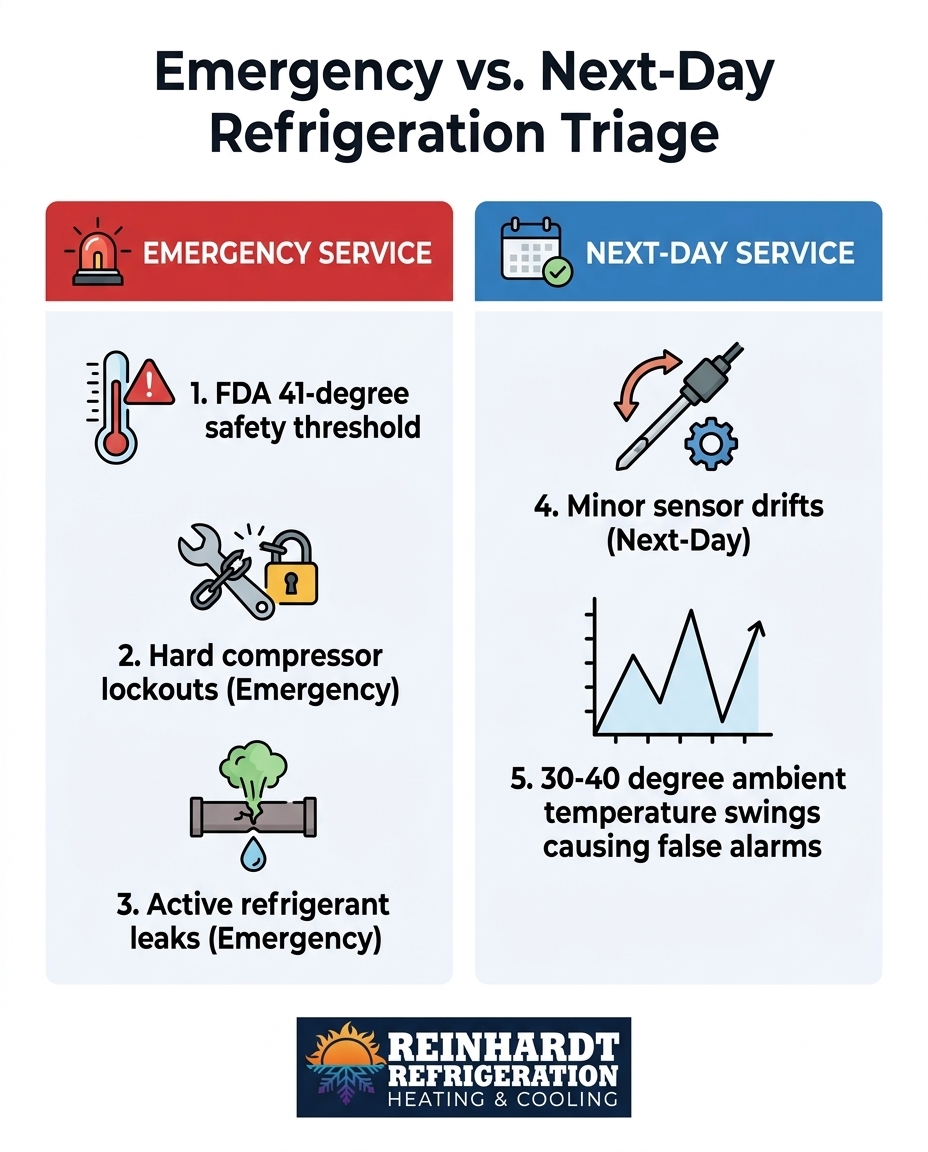
• Hard Compressor Lockout (Will not reset) — Triage Category: Immediate Dispatch — Required Action: Do not force reset. Call for 24/7 emergency service immediately.
• Active Refrigerant Leak (Hissing/Oil pooling) — Triage Category: Immediate Dispatch — Required Action: Shut down system. Request emergency dispatch to prevent compressor damage.
• Electrical Burning Smell or Repeated Breaker Trips — Triage Category: Immediate Dispatch — Required Action: Leave breaker off. Dispatch technician immediately for fire safety.
• Rapid Temperature Spike (Continuous climbing) — Triage Category: Immediate Dispatch — Required Action: Keep doors sealed. Call for emergency service to save inventory.
• Minor Sensor Drift (Stabilizes after 30 mins) — Triage Category: Standard Hours — Required Action: Monitor temperature trend. Schedule next-day diagnostic check.
• Slow Defrost Recovery (Temp drops after cycle) — Triage Category: Standard Hours — Required Action: Verify defrost schedule. Request standard service if cycles are too long.
• Cosmetic Icing or Minor Condensation Drips — Triage Category: Standard Hours — Required Action: Clean up water hazard. Schedule standard service to clear drain lines.
Quick-Reference Checklist:
• Check the display: Is there a specific error code indicating a lockout?
• Listen to the unit: Are there grinding, hissing, or buzzing sounds?
• Smell the air: Is there any hint of burning electrical wire or ozone?
• Monitor the trend: Has the temperature climbed steadily for 45 minutes?
If you answer "yes" to any of these checklist questions, trigger an emergency dispatch. If all answers are "no," you can safely schedule next-day service.
How Utah's Early Fall Climate Shifts Trigger False Alarms
Refrigeration systems do not operate in a vacuum; they are heavily influenced by the environment surrounding their outdoor condenser units. In our region, the specific climate plays a massive role in how control panels interpret system health. We frequently trace late-night panic calls back to September early fall ambient temperature transitions, which cause significant environmental stress on refrigeration components.
September in Utah is characterized by extreme day-to-night temperature swings. It is common to see ambient temperature drops of 30 to 40 degrees from daytime highs to midnight lows. When the sun goes down and the high-desert air cools rapidly, the thermodynamics of your refrigeration system shift drastically. The outdoor condenser, which was working hard to reject heat in 85-degree afternoon weather, suddenly finds itself operating in 45-degree night air.
This rapid ambient drop dramatically affects condenser head pressures. As the outside air cools, the refrigerant pressure drops quickly. If the system's fan cycling controls or head pressure regulating valves are slightly out of calibration, the system may interpret this sudden drop in pressure as a dangerous low-refrigerant charge. The control panel, acting on this misinterpreted data, throws a fault code and sounds the alarm.
Furthermore, Utah's arid environment and the specific elevation factors of the Uintah Basin impact refrigeration load calculations differently than humid or coastal climates. The dry air allows for rapid heat transfer, making these pressure swings even more pronounced. In many cases, these environmental shifts cause sensor miscalibrations and false alarms rather than true mechanical failures. Understanding this regional climate quirk helps facility managers realize that a midnight alarm in early fall is often just the system overreacting to the high-desert weather.
Mitigating Risk Before the Alert: Proactive System Management
The most effective way to avoid the stress of a midnight triage decision is to prevent the alert from happening in the first place. Transitioning from a reactive, emergency-only mindset to a proactive system management approach is the hallmark of a well-run facility. While knowing how to evaluate compressor lockout faults vs. minor temperature drifts is essential, stopping those faults from occurring saves both inventory and operational budget.
Regular system calibration is your first line of defense. Because industrial sensors are so sensitive to environmental changes, they must be checked and recalibrated before major seasonal temperature shifts occur. Having a technician verify that head pressure controls, fan cycling switches, and defrost timers are accurately dialed in for the upcoming season drastically reduces the chances of false alarms.
We strongly recommend establishing a routine maintenance plan to keep your system operating within correct parameters year-round. At Reinhardt Refrigeration Heating & Cooling, our routine maintenance goes beyond just changing filters; it involves deep-cleaning condenser coils to ensure proper heat rejection, checking refrigerant charge levels, and tightening electrical connections that vibrate loose over time. A clean, well-maintained condenser is far less likely to trigger a high-pressure lockout during a busy operational day, and properly calibrated sensors are far less likely to wake you up with a false alarm at 2 AM.
Make the Right Call for Your Facility's Refrigeration Needs
Protecting your commercial inventory requires a balance of quick action and level-headed assessment. By applying a clear triage framework, you can confidently distinguish between a minor sensor drift that can wait until morning and a critical hard lockout that demands immediate attention. This knowledge not only saves your perishable inventory during true emergencies but also protects your operational budget from unnecessary after-hours dispatch fees during false alarms.
Whether you are staring at a flashing control panel at 2 AM or dealing with a slow temperature drift at 2 PM, expert support is always available across the Uintah Basin. If your triage assessment points to a critical failure, do not hesitate to reach out for immediate 24/7 emergency service. If the symptoms indicate a non-critical fault, contact us to schedule a comprehensive next-day diagnostic check to keep your facility running smoothly.
Frequently Asked Questions
What qualifies as a commercial refrigeration emergency?
A commercial refrigeration emergency is any fault that immediately threatens product safety or risks severe equipment damage. This includes hard compressor lockouts, active refrigerant leaks, electrical burning smells, or a rapid, continuous rise in internal temperature toward the FDA 41-degree threshold. If the system cannot maintain safe temperatures and the issue cannot be reset, immediate dispatch is required.
How long can a walk-in freezer stay cold without power?
A well-insulated, fully stocked walk-in freezer can often maintain safe temperatures for several hours without power, provided the doors remain completely sealed. The dense thermal mass of the frozen product acts as a buffer against ambient heat infiltration. However, every time the door is opened, this safe window is drastically reduced, so monitoring the external temperature display without entering the box is critical.
When should I call for commercial refrigeration repair instead of waiting?
You should call for immediate repair if you hear mechanical grinding noises from the compressor, see oil pooling from a refrigerant line, or if the unit repeatedly trips its electrical breaker. These are signs of imminent catastrophic failure. If the issue is simply a slow defrost cycle or a minor condensation drip, it is usually safe to wait and schedule standard next-day service.
What causes a compressor lockout on a commercial freezer?
A compressor lockout is typically caused by the system's internal safety switches detecting extreme high head pressure or dangerously low suction pressure. This can be triggered by a severely clogged condenser coil, a failing condenser fan motor, or a significant loss of refrigerant. The lockout severs power to the compressor to prevent it from burning out or seizing mechanically.
Can early fall temperature drops in Utah cause my commercial freezer alarm to sound?
Yes, the extreme 30-to-40-degree ambient temperature drops common in Utah during early fall can trigger false alarms. The rapid cooling of the outdoor air causes a sudden drop in condenser head pressure, which sensitive control panels sometimes misinterpret as a low refrigerant charge. This often results in a warning alert even though the internal mechanical components are functioning fine.
How do I know if my refrigeration alert is just a sensor drift?
A sensor drift usually presents as a brief, minor temperature spike on the display that does not correspond with an actual loss of cooling. If the alarm sounds but the temperature stabilizes or returns to normal within 30 to 60 minutes without intervention, it is likely a temporary drift. Checking the trend over an hour will confirm whether the system is actually failing or just recalibrating to environmental changes.
Book Expert Service Or Contact Us
Clients Say About Us
Customer Testimonials
Customers appreciate our reliable service, clear communication, and the peace of mind that comes from knowing their HVAC needs are handled by experienced professionals.
Very happy with their service. We had a different company install a heat pump for us and they totally messed everything up. Reinhardt was willing to work with us and help us out even though it was not their mistake. They were fast and fixed the issues. I appreciate their help and will use them again!
Gary H.

Thank you for your customer service.. My furnace wasn’t getting power.. There service repair man came within a couple of hours of calling and fixed the problem.. I appreciate them accommodating me so quickly..
Pearl W.
Prompt Courteous Service ! We highly recommend Reinhardt for all your HVAC needs. The Best !!!!
Mike Y.
These guys are truly truly the best. They have saved us from scorching heat (it was sure hot a couple times when the AC needed something ) and freezing cold (when fixed the heater). Can't even come close to saying how great they are!
Lynne B.
My AC went out and they were able to come the next day. Fixed in about 30 minutes. Great service.
Cody A.
Working with Paul has been great. He was prompt with his communication with me, timely in his service and fair with his price! Everything I was looking for in someone to do HVAC for my new house!
Blake J M.
I just have to say thank you to them for the work they do. Reinhardt came out when our heat pump was dripping water in places where it shouldn't. They were very courteous and prompt. Definitely a great team there and I highly recommend them.
Steven T.
I will use them for all of my hvac needs! They came and installed a new AC unit for me and they were done in an afternoon. Their pricing is fair and they were so friendly! Didn’t seem like an issue to get me in like some other companies.
Lexie R.
Ready to Transform your Home?
Pre-Qualify Without Impacting Your Credit


Related Articles